This seems quite an interesting resource.
Monday, April 30, 2012

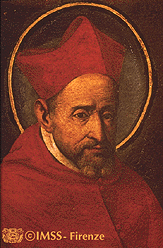
Upon searching for Cardinal Bellarmine Online, I have found a variety of resources, however the most promising sites contain primary source documents (or their translations) that should prove invaluable to playing the part. The downside is that there seems to be only one painting/portrait of Bellarmine, and thus props might be an issue.
The character of Cardinal Bellarmine, online information;

http://galileo.rice.edu/chr/bellarmine.html
http://en.wikipedia.org/wiki/Robert_Bellarmine
http://www.newadvent.org/cathen/02411d.htm
http://law2.umkc.edu/faculty/projects/ftrials/galileo/keyfigures.html#Bellarmine
Primary Document Translations:
http://www.fordham.edu/halsall/mod/1615bellarmine-letter.asp
http://www.creationism.org/csshs/v11n3p18.htm
http://law2.umkc.edu/faculty/projects/ftrials/galileo/bellarminestatement.html
http://galileo.rice.edu/chr/bellarmine.html
http://en.wikipedia.org/wiki/Robert_Bellarmine
http://www.newadvent.org/cathen/02411d.htm
http://law2.umkc.edu/faculty/projects/ftrials/galileo/keyfigures.html#Bellarmine
Primary Document Translations:
http://www.fordham.edu/halsall/mod/1615bellarmine-letter.asp
http://www.creationism.org/csshs/v11n3p18.htm
http://law2.umkc.edu/faculty/projects/ftrials/galileo/bellarminestatement.html
Sunday, April 22, 2012
This resource, while not the most professional source, may yet offer some information if only as fanciful conjecture. At any rate, I found this article informative, even if it does need to be taken with a grain of salt.
Click HERE for the link to "History of Coffered Ceilings" article
Click HERE for the link to "History of Coffered Ceilings" article
Wednesday, April 18, 2012
The donation of Constantine Click HERE is an actually interesting read, if you can skim it accurately, and for the most part, is full of thee's and religious rhetoric. Nevertheless, still interesting.
Tuesday, April 17, 2012
Saturday, April 14, 2012
Machiavelli's The Prince has many solid concepts that I can relate with, however the allusions to classical figures and people from the then contemporary Italy (divided as it was by city states) does place a limit on my comprehension. What I ended up doing was reading the parts where Machiavelli describes the topic of the chapter, and then selectively read the actions of whomever Machiavelli chose to exemplify what to do or what not to do. Overall however, it's a quite interesting read, not the most intriguing concepts in the world, but not as dry as I had expected.
Well, I must say that Giovanni and Lusanna was quite an interesting read. Not what I would typically read, however I found that it was a refreshing break from the generalizations that identify most history texts. This "microhistory" was a pleasant surprise in that it allowed me to infer the significance of people's actions instead of the usual broad statements that characterize our other text. Overall, I found that Giovanni was a putz, and that Lusanna deserved a lot more than she got. However, living in modern times and contemporary mores, I must admit that I am biased.
Thursday, April 12, 2012
Tuesday, April 10, 2012
Monday, April 9, 2012
Also, I found 1 possible origin of Quarentining; found here --> http://
Subscribe to:
Posts (Atom)